Home Shop Service Jobs Newsletter Company Sitemap Entertainment Shopping cart Deutsch
Journals | Journals from A to Z | Angewandte Chemie International Edition | info |
Browse our products
Books
Journals
Journals from
A to Z
Online Submission
of Manuscripts
Highlights and special offers
New journals
Latest issues
Journals price list
Featured sites
Entertainment
Electronic Media
Choose your area of interest
 

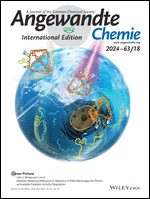
49_08/2010Cover Picture: Nanoparticulate Functional Materials (Angew. Chem. Int. Ed. 8/2010)

Nanoscientists boldly go to the frontiers of the smallest solids in basic science and their technical application. In their Review on page 1362 ff., H. Goesmann and C. Feldmann point to the visionary potential of nanoparticulate functional materials. After a general introduction of the topic, the optical, electrical, magnetic, and catalytic properties of nanoparticles as well as their potential for upgrading materials are summarized. Moreover, fundamentally novel shapes and compositions of matter are presented.

Read Full Text  | Table of Contents

Also of Interest

Biosensorsfor001

Detection of energy transfer from luminescent terbium complexes to semiconductor quantum dots allows a fivefold multiplexed bioassay. In their Communication on page 1396 ff., N. Hildebrandt et al. report sub-picomolar detection limits for five bioanalytes.


Frustrated Lewis Pairsfor002

In their Communication on page 1402 ff., S. Grimme, G. Erker, and co-workers use a state-of-the-art theoretical analysis to determine the deciding factors in the activation of dihydrogen and other small molecules with frustrated Lewis pairs.


ATP Detectionfor003

A fluorescence-quenching process delivers spatiotemporal information of ATP in living cells. M. S. Strano and co-workers present a highly sensitive nanotube-based sensor that uses this principle in their Communication on page 1456 ff.


49_08b/2010Inside Cover: Thin-Film Formation of Imidazolium-Based Conjugated Polydiacetylenes and Their Application for Sensing Anionic Surfactants (Angew. Chem. Int. Ed. 8/2010)

The stimulus-induced blue-to-red transition of polydiacetylenes (PDAs) has led to the development of a variety of PDA-based chemosensors. In their Communication on page 1422 ff., J. Yoon, J. Y. Lee, and co-workers describe an anionic-surfactant-selective sensor based on PDA and imidazolium, which shows selective color response to anionic surfactants. Furthermore, this system easily distinguishes between the anionic surfactants sodium dodecyl sulfate (SDS) and sodium dodecylbenzenesulfonate (SDBS).

Read Full Text  | Table of Contents


Deutsche Ausgabe

Gesellschaft Deutscher ChemikerA Journal of the

Contact

Subscribe now!

Advertise

News

20-Oct-2009
Meet Angewandte on Your Favorite Social Network

28-Jan-2010
Do You Want to Join the Angewandte Team?

08-Feb-2010
Hot Paper: A Polybenzo[1,2-b:4,5-b']dithiophene Derivative with Deep HOMO Level and Its Application in High-Performance Polymer Solar Cells

 more News >> 

By authors of Angewandte: D. Astruc (Ed.): Modern Arene Chemistry


Tell a friend          RSS Feeds             Print-Version

©2010 Wiley-VCH Verlag GmbH & Co. KGaA - Provider
http://www.wiley-vch.de - mailto: info@wiley-vch.de
Data Protection